Between the head and the earth: traditional african textile art
August 2024 to February 2025 - Pinacoteca de São Paulo, Brazil
in partnership with Maison Gacha (Paris, France) and Fondation Jean-Félicien Gacha (Bangoulap, Cameroon).
Between the Head and the Earth: Traditional African Textile Art, developed in collaboration with Maison Gacha, based in Paris, France, and the Jean-Félicien Gacha Foundation, based in Bangoulap, Cameroon. Divided into seven sections, the exhibition features 129 textile pieces that aim to inspire new perceptions of Africa among the Brazilian public, offering a diverse and multifaceted view of a continent rich in knowledge, traditions, and artistic contributions. Curated by Renato Menezes and guest curator Danilo Lovisi, the exhibition stems from research into ancestral textile technologies and the transmission of traditional African knowledge.
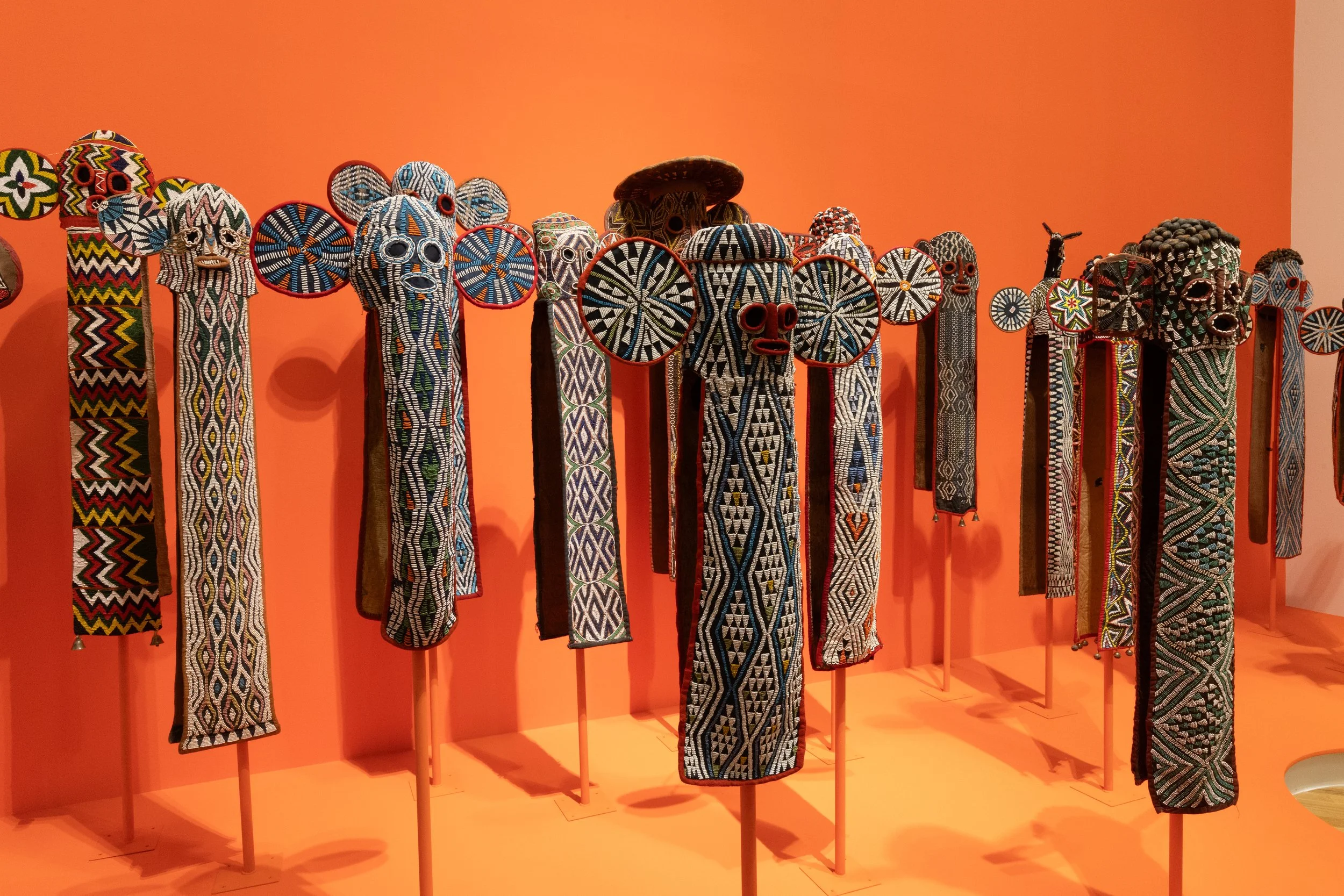
The curators visited various regions of Cameroon to engage with local leaders, authorities, institutions, and artisans, a process that was crucial to the development of the exhibition. The objects on display, mostly from the collection of the Franco-Cameroonian institution, are crafted from diverse materials and serve multiple functions, offering insight into the rites and cosmologies of various African peoples. Among the pieces, there are masks, tunics, adornments, embroidered and dyed fabrics, as well as statuettes, which help tell a story that travels between the head and the earth – that is, between the individual Ndop fabric. Western Cameroon, Bamiléké people. Gacha Foundation Collection Elephant mask. Western Cameroon, Bamiléké people. Gacha Foundation Collection intelligences and creative freedoms exercised by each artisan and the earth, a place associated with the preservation of traditions and the connections to collective identities.




“Our aim, with this exhibition, is to present a vision of Africa as a diverse and rich continent, inhabited by various cultural groups that are true reservoirs of knowledge, born from a direct experience of observing and transforming nature. We want to speak of an Africa detached from the colonial trauma, a continent where artisans abound, whose craftsmanship rivals that of the great masters of haute couture. Viewing these textiles allows us to reach an initial conclusion: we have much to learn from these artists, both in the creation of these works and in the techniques of preserving them,” state the curators.
It is the first time that such an important collection of works is being presented to the Brazilian public, which is still largely accustomed to associating African textiles with colorful, industrially produced prints. Throughout the seven exhibition rooms in the Pina Luz building, visitors can engage with works that emerge from a body of ancestral artisanal knowledge – pieces whose production process can take weeks, even months. The exhibition aims not only to showcase these textiles but also to interconnect them, highlighting the cosmopolitan nature of different African societies and challenging the notion that this artistic production is of lesser value.
In the first room, “Animal Geometry,” the curatorial focus is on the significance of animals for cultural groups such as the Bamiléké, Bamun, and Wuraki from the west and northwest of Cameroon. Panthers, jaguars, crocodiles, and elephants are rendered in more figurative or abstract forms, depending on the artisan’s creative freedom. Visitors will be greeted by an exceptional collection of over twenty elephant masks of various sizes, all intricately embroidered with multicolored glass beads, used by the Bamiléké.
Next, in the second section, “Plant Blue”, a diverse array of indigo-dyed textiles, created using different techniques, is on display. Indigo, a deep blue hue obtained through the manipulation of indigo plants, appears in ndop cotton fabrics, in the adire of the Yoruba, and in the Baoulé textiles of the eponymous cultural group from Côte d’Ivoire, among others. The traditional process of producing Cameroonian ndop involves a lengthy production chain. It starts with the farmer who cultivates the cotton and extends to the indigo dyeing specialist, the artisan responsible for designing on the raw fabric, the one who ties the raffia bindings – preserving areas from the blue dye – and finally the individual who removes these bindings. Each person in this chain is trained by the previous generation to fulfill their role. By the end of the process, the fabric attains the significance of a jewel: only kings and distinguished members of the community have the right to wear it.
In the third section, “Language Technology”, a dialogue is presented between the kente and the ewe – regal fabrics used by the Ashanti and Ewe – and the ndebele, neck adornments used by the Nguni people of South Africa, exploring the idea of language and communication as a form of graphic technology.
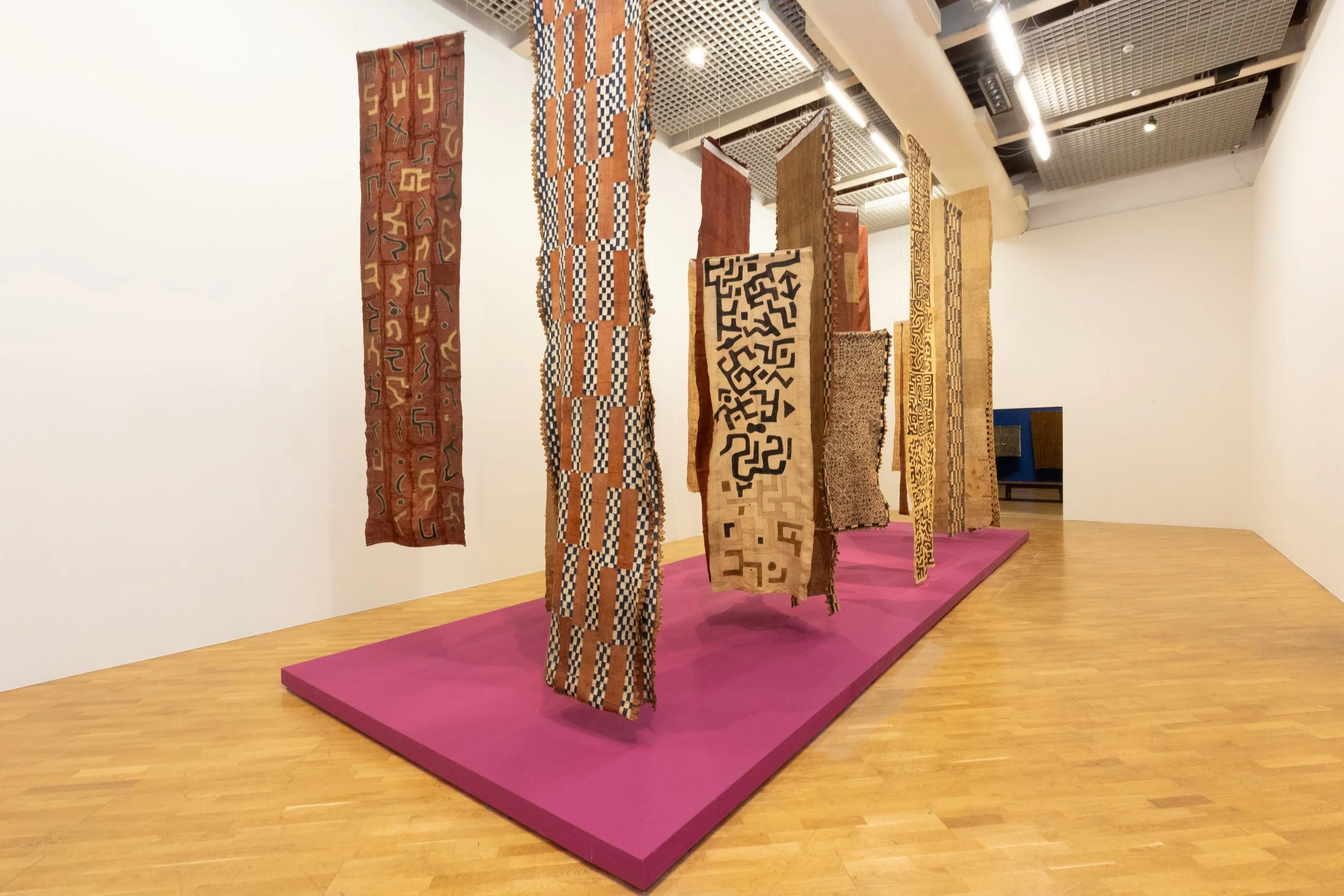
Following this, the fourth section, “The Bead Route”, showcases a collection of textiles and sculptures that share a common use as a canvas for the creation of symbols with multicolored glass beads, crafted by various cultural groups such as the Bamileke and Yoruba. In the following room, the section “Opacity and Transparency” aims to create a dialogue between a collection known as “kassai velvets,” produced by the Shoowa people from the Kassai province in the Democratic Republic of the Congo, and melhfa cotton veils made in Mauritania.
The kassai velvets combine various textures and shades, always opaque, resulting from a collective embroidery process, while the veils are distinguished by their lightness and translucency. In the sixth section, “The dance of shapes”, fabrics installed in the center of the room impart a sense of choreography to the diverse textiles produced by the Kuba, including the ntshak from the Democratic Republic of the Congo, engaging in dialogue with appliqué pennants that are prevalent in Benin, in the former Kingdom of Dahomey. The seventh section, “Earth Paints,” concludes the exhibition by presenting a collection of Bògólan fabrics from Mali, made with a mixture of mud and herbs.